What a Trillion Dollars Could Never Buy
by Father Brian J. Soliven on Sunday June 7, 2026
To enter into the mystery of the Eucharist – this baffling teaching that Jesus is truly and fully present in the “bread” and “wine” at each Holy Mass – one thing is required above all else: love. For love is not merely an affection; it is a kind of sight. It enables us to look through things rather than merely at them. Without love, we remain trapped upon the surface of reality, mistaking appearances for the whole truth.
Consider a bride and groom standing before one another on their wedding day. The guests may admire the elegance of the dress or the sharpness of the suit, but the true spectacle is elsewhere. It is written upon their faces. Their eyes are fixed upon one another with a gaze that seems almost to forget the rest of the world. To everyone else, the man is simply a man and the woman simply a woman—a son, a daughter, a friend, a relative. Yet to the lovers themselves, something more is revealed. Love has uncovered a depth invisible to the casual observer. They behold in one another a mystery, a significance, a glory that others can only dimly perceive.
Love, then, is not a departure from reality but an entrance into it.
This sheds light upon our Lord's question to His disciples: “Who do you say that I am?” One might paraphrase it: What do you see when you look at Me? The crowd had their answers. Some said John the Baptist, others Elijah, still others Jeremiah or one of the prophets. Their answers were not entirely wrong, but they remained upon the surface. They saw only what natural sight could perceive.
Then Peter spoke. By a grace granted from above, he looked beyond the ordinary features of the carpenter from Nazareth and exclaimed, “You are the Messiah, the Son of the living God.” Peter had begun to see with the eyes of love. He perceived that the man standing before him was infinitely more than a man. Just as the bride sees more than a man in her beloved, Peter saw more than humanity in Jesus. He saw divinity concealed beneath humility.
The same question confronts us whenever we stand before the Eucharist.
What do you see?
Everything in our senses protests against the mystery. The eye sees bread. The tongue tastes bread and wine. The appearances remain stubbornly ordinary. Yet Christ's words in the sixth chapter of John's Gospel continue to confront every generation with the same unsettling challenge: “My flesh is true food, and my blood is true drink.” Many who heard Him could bear it no longer. They turned away, preferring a faith that remained within the boundaries of what could be easily understood.
Then Jesus asked the Twelve the question that every lover dreads to hear: “Do you also wish to go away?” Love never compels. It invites. It leaves room for refusal.
Peter's answer is one of the great declarations of love in all Scripture: “Master, to whom shall we go? You have the words of eternal life.” Notice that Peter does not claim to understand everything. He remains because he has come to know the One who stands before him. Love has carried him beyond mere appearances. He trusts the Person even when the mystery exceeds his understanding.
And so the question remains for us.
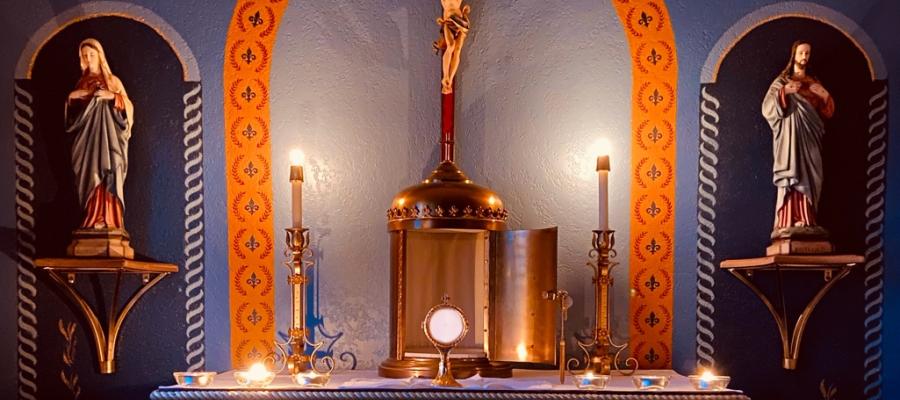
When you gaze upon the Eucharist, what do you see? Mere bread? A religious symbol? Or do you see, hidden beneath the veil of ordinary things, the relentless love of God pursuing His lost children? The saints saw Christ there—giving Himself without reserve, pouring Himself out for the life of the world.
What do you see?