What Makes For a Good Father?
by Father Brian J. Soliven on Sunday June 21, 2026
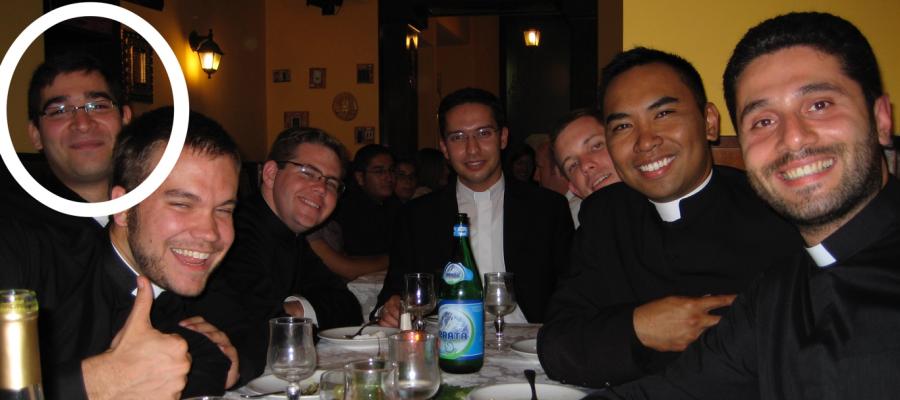
Whenever I look at the photograph on the cover of this Sunday’s bulletin, I am filled with many emotions at once—happiness, gratitude, nostalgia, and also a deep sadness. It was taken in the fall of 2009 in Rome. We had gathered at a restaurant to celebrate the ordination of a friend. There was good wine, wonderful Italian food, and the easy laughter. The joy on our faces tells the story better than words.
At the time, everyone in the picture was still a seminarian, studying together for the priesthood. One of the great gifts of living in Rome, at the heart of the Catholic Church, is that you begin to see with your own eyes how truly universal the Church is. Men come from every corner of the world. In that photograph alone are seminarians from different parts of the United States, along with brothers from Iraq and Syria. Around that table, we were many nations, but one family.
And this is where the memory makes me sad. In the upper left-hand corner, with the circle around his face, is Mikele, then a seminarian from Syria. We became friends through our classes and over many conversations shared with cappuccinos during breaks. From time to time, he would come to the American seminary where we lived and join us for lunch.
After our years of study, we all returned to our own countries to serve Christ and His Church as priests. For a long time I heard nothing of Fr. Mikele. Then one day, quite unexpectedly, a mutual friend called me. “I have terrible news,” he said. “Do you remember Fr. Mikele from seminary? He has been kidnapped by terrorists.”
I was stunned. Such things seem very far removed from our lives here in America, thanks be to God. Yet for many Christians throughout the world, they are terrible realities.
Fr. Mikele had been delivering supplies to one of our Catholic schools in Damascus, the capital of Syria, where the Islamic terrorist group Hezbollah was active. Though the danger was well known, he and other Catholics boarded a bus bound for the city. Along the way, armed men stopped the vehicle. They climbed aboard with rifles in their hands and slowly made their way down the aisle. Looking upon the frightened faces of the passengers, they pointed to the two Catholic priests, Fr. Mikele being one of them, and dragged them off the bus.
Not long afterward, the Archbishop of Damascus received a call demanding a ransom for the release of his priests. With great sorrow, he refused, knowing that yielding to such demands would only encourage further kidnappings. Fr. Mikele’s mother pleaded for her son’s freedom, but there was nothing she could do. The kidnappers wanted money—more money than anyone possessed.
Then, one day, the calls ceased. There was only silence. It has now been more than a decade since anyone has heard from Fr. Mikele. No letters. No messages. No word at all. Sadly, we must presume the worst.
I tell this story because my friend’s name will never appear in the headlines. He was not a famous man. He was a simple Catholic priest trying to serve his people in a dangerous part of the Lord’s vineyard. He was a good man, a prayerful man, and a man who loved Our Lord with his whole heart. Fr. Mikele reminds me of the words of Our Lord in this Sunday’s Gospel:
“Do not be afraid of those who kill the body but cannot kill the soul.… Are not two sparrows sold for a small coin? Yet not one of them falls to the ground without your Father’s knowledge.… So do not be afraid; you are worth more than many sparrows. Everyone who acknowledges me before others I will acknowledge before my heavenly Father.”
The world may forget such men. Newspapers may never print their names. But Heaven does not forget them. The Father who counts the hairs on our heads has surely not forgotten one of His faithful servants. And whether Fr. Mikele died at the hands of his captors or still lives in some hidden place known only to God, we may be certain of this: no act of love offered to Christ is ever lost, and no servant who acknowledges Him before men will be forgotten by the Master whom he served.