Tunnels Filled With the Bodies of the "Dead"?
by Father Brian J. Soliven on Sunday November 1, 2026
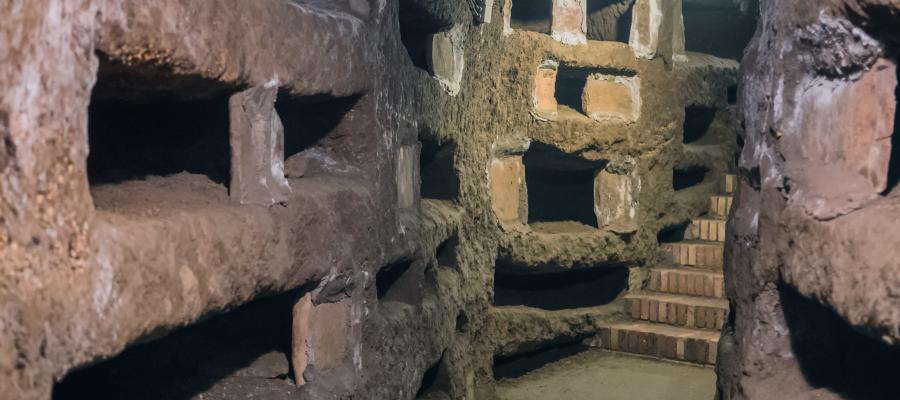
Beneath Rome lies a city most visitors never see. Hundreds of miles of galleries wind through soft volcanic rock, and scholars commonly estimate that some 750,000 people were buried there between the second and fifth centuries. Most were ordinary believers: laborers, slaves, mothers, children. This was not a handful of secret burials but a whole people, generation after generation, laying their dead in the same way.
Roman culture saw death as a grim ending, and cremation was common. The Christians buried their dead, as Christ was buried, and called the place a koimeterion, a sleeping-place. Those in the niches were waiting for the resurrection. The walls bear the same hope: the Good Shepherd, the anchor, the praying figure, and epitaphs like "Live in God" and "In peace." For a community that knew persecution firsthand, there is remarkably little despair.
Christians gathered at the tombs of martyrs on the anniversary of their deaths, which they called their birthdays, the day they were born into heaven. There they celebrated the Eucharist, often with the altar set directly over the burial place. The Catacomb of Callixtus preserves the crypt of several third-century popes, and nearby lies Saint Cecilia, one of Rome's most beloved martyrs.
The logic flowed from the heart of the faith. If Christ had conquered death, those who died in him were more alive, not less. The Church on earth and the saints in heaven were one body, and the Mass, where heaven and earth meet, was the natural place to feel that unity. Revelation pictures the martyrs beneath the altar in heaven, and the early Christians set their altars above them on earth.
Our age tends to hide death or soften it with euphemism. The early Christians went down into the dark, sang at the graves, and shared the Body and Blood of Christ over the bones of the faithful departed. They believed death is not the end, that the dead in Christ remain part of the family, and that worship unites the living and the saints. Seventeen centuries later, the catacombs still say the same thing: those who die in Christ are not lost. They are near.